
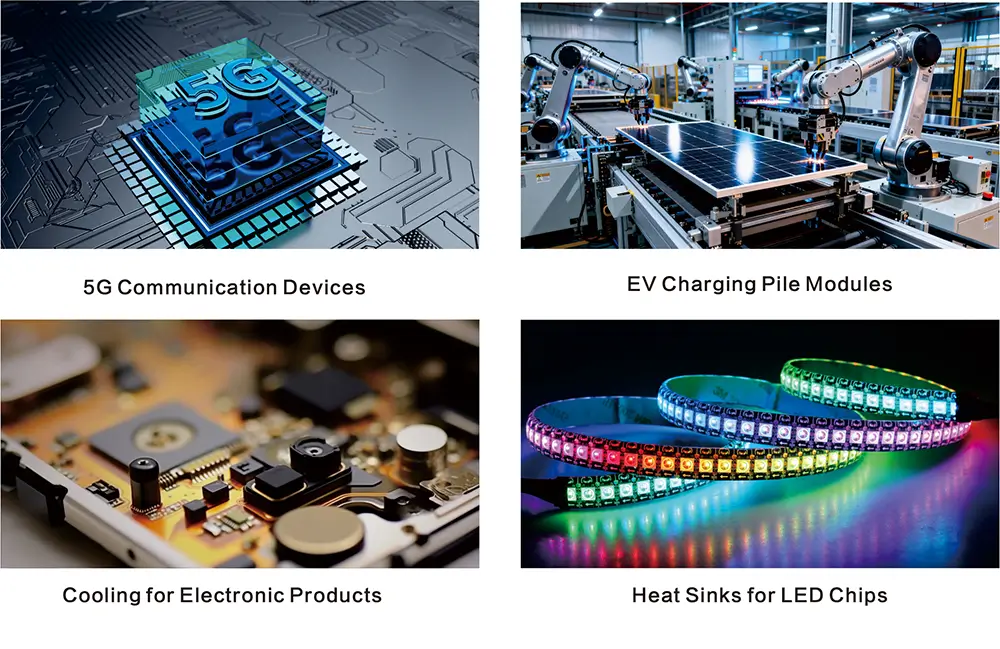
In EV chargers, a thermal interface material must deliver more than a high thermal-conductivity value on the datasheet. It also needs to fill the actual gaps between components and maintain stable, controllable dispensing on the production line.
For structures with uneven clearances, gap-filling thermal gels can conform to different component heights and gap profiles, making them suitable for automated or semi-automated dispensing. The right grade still depends on bond-line thickness, component-height variation, assembly pressure, and the dispensing process. Thermal conductivity alone is not enough to determine production suitability.
MAXTOR MT-4204 is one option in the Maxtor thermal-gel range, with a product-data thermal conductivity of approximately 4 W/m·K. We recommend validating the material under the actual component and process conditions—including gap dimensions and dispensing parameters—before moving to production trials.
If you are developing a power module or EV charger, share the application area, actual gap size, component-height variation, and dispensing process. We can then help identify a suitable material direction and provide the relevant technical data or sample recommendations.
 English
 Chinese
 Russian
 Vietnamese